[ Blog ]
California Construction Overtime, Explained
September 14, 2026
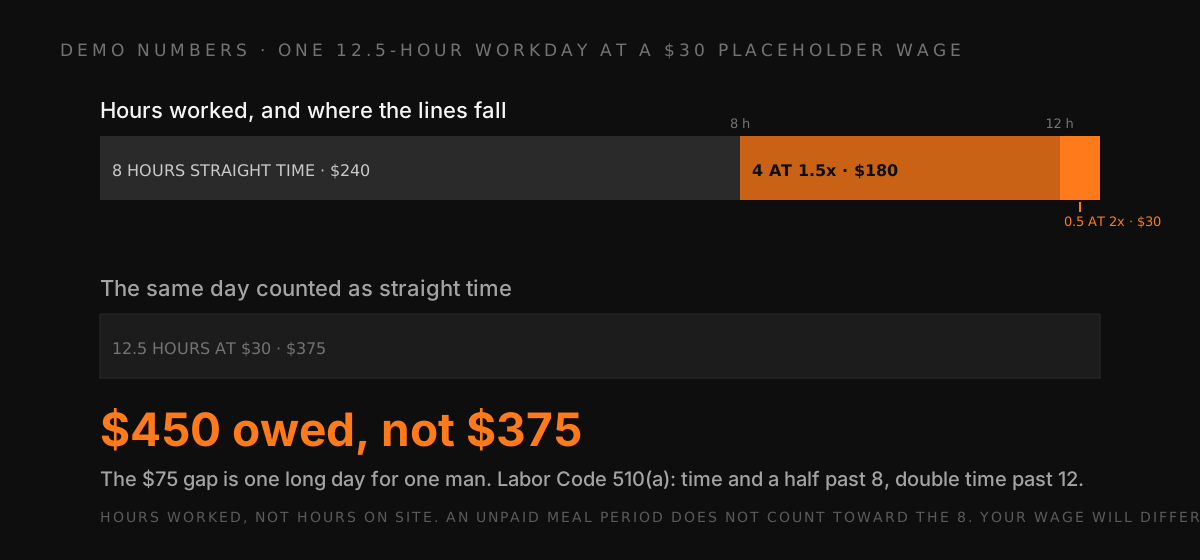
In California, an hourly (nonexempt) construction worker earns time and a half after 8 hours in a workday and after 40 hours in a workweek. Past 12 hours in a workday the rate is double time. The seventh consecutive day of work in a workweek pays time and a half for the first 8 hours and double time after that. That is Labor Code section 510, and the construction wage order carries the same rule.
That one paragraph is where the confusion starts for anyone who learned payroll under federal rules, because federal law counts overtime only by the week. This post walks the California rules as they apply to a crew. It covers the daily lines, the workday, the seventh day, four 10s, prevailing wage jobs, the regular rate, and the records behind a challenged paycheck. Every rule links to the statute or the state's own page. Every dollar example is demo math at a $30 placeholder wage.
This is general information for contractors, not legal advice. The sources were retrieved on the date in the footer, and rules change. Confirm anything you act on with the Labor Commissioner's office or your attorney.
The daily lines: 8 and 12
The statute opens plainly: "Eight hours of labor constitutes a day's work." Past 8 hours in a workday the rate is at least one and one-half times the regular rate. Past 12 hours it doubles: "Any work in excess of 12 hours in one day shall be compensated at the rate of no less than twice the regular rate of pay for an employee." Both lines are in section 510(a). Wage Order 16, the order that covers on-site construction, drilling, logging, and mining, carries the same 8 and 12 in section 3.
The lines are measured on hours worked, not hours on site. The state's overtime FAQ says overtime "is calculated based on hours actually worked," so an unpaid meal period does not count toward the 8. That detail is exactly where a construction worker on Reddit and the employer disagreed in 2023: "So I worked 13hrs one day. I assumed that I would get paid 7.5hrs at my normal wage(due to my unpaid lunch), 4hrs at 1.5x wage, and 1hr at double time. The company is paying me 8hr at my normal wage, 4hrs at 1.5x wage, and 0.5hr at double time." Both versions total 12.5 hours worked. Run the rule on 12.5 hours worked. The lines fall at 8 and 12: 8 straight, 4 at time and a half, half an hour at double time. That is the second version.
At a $30 demo wage, that day pays $450: 8 hours at $30, 4 hours at $45, and half an hour at $60. Counted as straight time it would be $375. The $75 gap is one pour day. A crew of four with two of those days a week is $600 a week. If the bid assumed weekly overtime only, none of it was budgeted.
The daily and weekly lines do not stack. Section 510 does not require paying two overtime rates for the same hour. The state does not count an hour already paid as daily overtime toward the weekly 40. Five 9-hour days is 45 hours with 5 hours of overtime, not 5 daily plus 5 weekly. The state's enforcement manual puts the workday rule this way: "A workday is a consecutive 24-hour period beginning at the same time each calendar day, but it may begin at any time of day" (section 48.1.2). Daily overtime is due on the hours inside that period, with no averaging across days. The manual expects a workday start that is fixed and written down. The manual says a workday can be changed only if the change is meant to be permanent and is not designed to dodge overtime.
The seventh day
Section 510 also covers the seventh consecutive day of work in a workweek. The first 8 hours pay time and a half, and everything after that pays double time. It applies inside one workweek. A crew that works Tuesday through the following Monday has not necessarily hit a seventh day, because the workweek boundary sits in the middle. The California Supreme Court, reading the separate day-of-rest sections 551 and 552, held in 2017 that "A day of rest is guaranteed for each workweek. Periods of more than six consecutive days of work that stretch across more than one workweek are not per se prohibited."
That is why the workweek definition matters as much as the workday. The workweek is defined in writing, kept fixed, and the seventh day is counted inside it. A payroll poster on Reddit asked in 2023 about a worker on seven straight 4-hour days, 28 hours total, and whether day seven owed a premium. Labor Code 556 only lifts the day-of-rest rule in sections 551 and 552. It applies when the week is 30 hours or fewer and no day passes 6. The state's manual says the seventh-day premium in 510(a) is still owed on those hours (section 48.3). Seven days in a row inside one workweek is a premium day, full time or part time.
Four 10s, and the vote that makes them legal
Some crews like four 10-hour days, especially outdoors. A journeyman carpenter on Breaktime made the case in 2006: "Under the aforementioned conditions, the best schedule for outdoor work is 4 10-hour days. If it rains Monday thru Thursday, 8-10 hours of it can be made up on Friday." In the same post he said overtime after 8 was "not law, but it is a union standard." Wherever he wrote from, in California it is the law. A Bakersfield roofer on ContractorTalk asked the obvious question in 2009: "Isn't anything over 8 hours a day legally subject to overtime wage rates?"
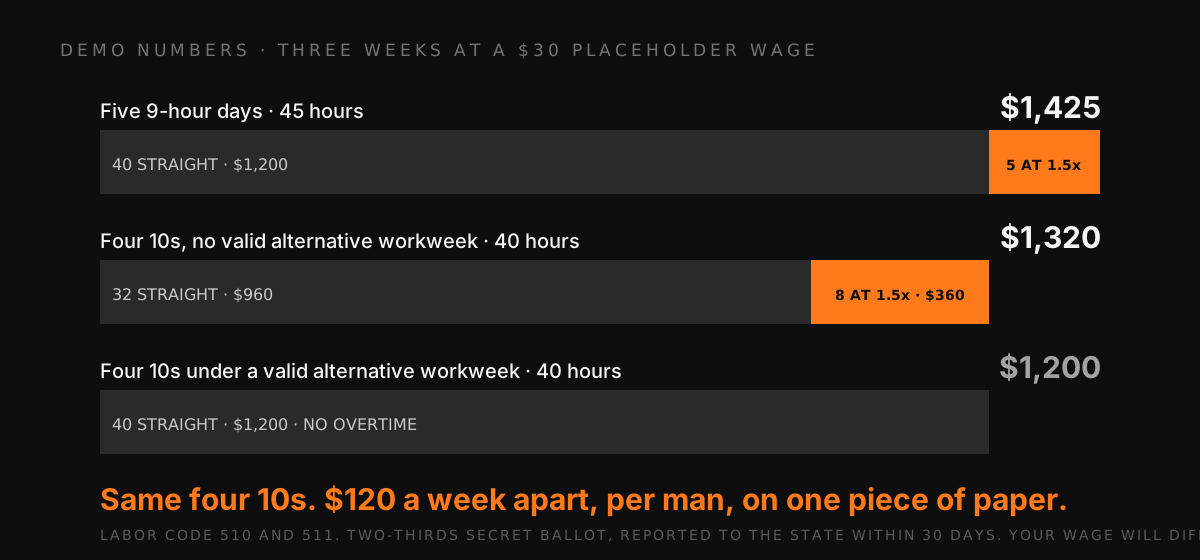
It is, unless the crew adopted an alternative workweek schedule the way Labor Code 511 requires. A union agreement that qualifies under section 514 is the other exception. The employer proposes the schedule in writing. The affected employees vote by secret ballot, and the proposal "shall be deemed adopted only if it receives approval in a secret ballot election by at least two-thirds of affected employees in a readily identifiable work unit." Wage Order 16 section 3(C) adds the mechanics. There is a written disclosure and a meeting at least 14 days before the vote. The disclosure also goes out in any language that at least 5 percent of the affected employees primarily speak. Skipping the disclosure step voids the election. The election is held before the work starts. The result goes to the state within 30 days and lands in a public database anyone can search by company name.
Inside a valid schedule, section 511(b) still owes time and a half for hours past the schedule up to 12, and double time past 12. Without a valid schedule, hours 9 and 10 each day are overtime, every day. An owner of a 17-employee California company asked in 2025 about one employee's request. The employee wanted 9 hours Monday through Thursday and 4 on Friday to make a class. Under the default rule, each of those 9-hour days carries an hour of overtime, no matter that the week totals 40. There is one narrow exception. If the employee asks in writing to make up time lost to a personal obligation in the same workweek, Labor Code 513 applies. Those makeup hours skip daily overtime up to 11 in a day and 40 in the week. The employer may not solicit the request.
A small paint shop's crew in Northern California held their vote in 2023 and then were not sure what to do next. The answer is the 30-day report to the state. Skip it and the election is not reported the way section 511(e) requires.
Prevailing wage jobs
Public works add a layer. Labor Code 1815 permits work past 8 hours a day and 40 a week on public work only "upon compensation for all hours worked in excess of 8 hours per day at not less than 1½ times the basic rate of pay." The exact overtime, holiday, and shift rates come from the prevailing wage determination for the craft and county. Those are the rates you pay. Labor Code 1813 adds a penalty of "twenty-five dollars ($25) for each worker employed in the execution of the contract" for each calendar day. It applies to each day a worker is required or permitted to work past 8 hours a day and 40 a week, contrary to the article.
The paystub is where it gets checked. A non-union low-voltage tech in Southern California wrote in 2023 that a labor attorney reviewed seven years of paystubs: "It is somewhere around $14k that I was underpaid." The tech then had to rebuild where each day was worked, because the paystubs never named the jobsite. In the poster's words: "And since my paystubs don't have the jobsite or address on it, I'm having to check my google maps timeline and see where I was working for every day I worked ..." Hours by job, on the record, is not just a costing habit. On public work it is the paper trail.
The regular rate is not always the hourly rate
Overtime is a multiple of the regular rate of pay, and the regular rate is broader than the number on the offer letter. The enforcement manual says it "includes many different kinds of remuneration, for example: hourly earnings, salary, piece work earnings, commissions, certain bonuses, and the value of meals and lodging" (section 49.1.2.2). A crew paid two rates in one week, say a laborer rate and an operator rate, uses a weighted average. Divide the total earnings for the workweek by the total hours worked, per the state's overtime FAQ. On a prevailing wage job, the determination's overtime rate is the floor for the hours worked there.
A day rate is not against the law by itself. It still has to turn into an hourly regular rate, and overtime is owed on top of it. When the Labor Commissioner cited a drywall contractor in 2018, then-Commissioner Julie A. Su put it this way: "a daily or other flat rate system does not take the place of minimum wage and overtime obligations." A California construction worker hired at $180 a day found this out on the first stub in 2020: "I worked exactly 40 hrs last week but my paystub is showing 40 regular time hours and 10 overtime hours. The dollar amount adds up to $180/day but the way they got to that number is way off."
What it costs when the hours are wrong
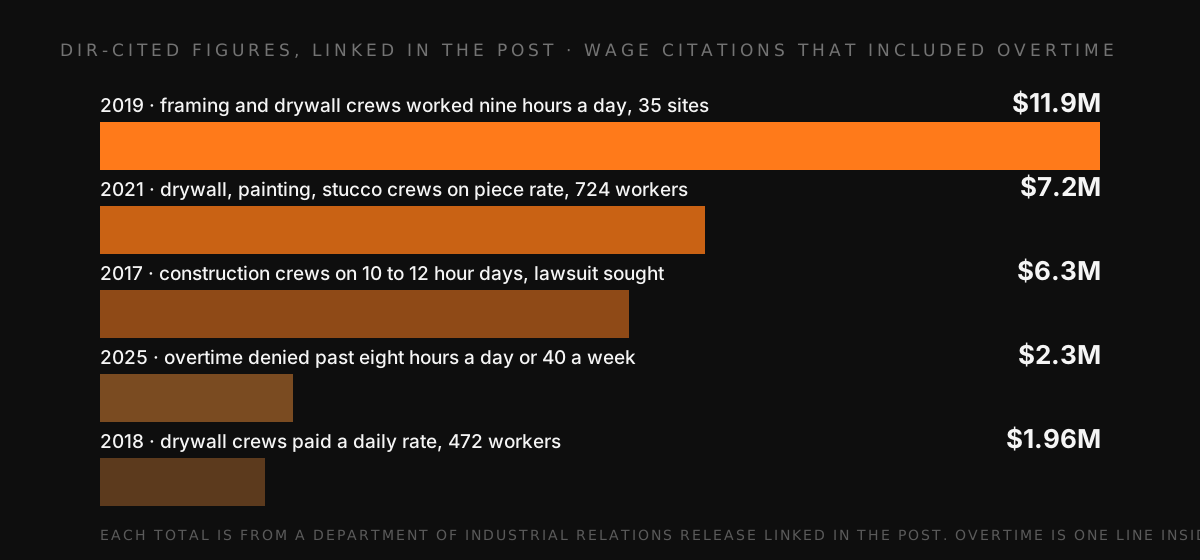
The Labor Commissioner publishes its construction citations and lawsuits. Overtime is one line inside each, next to rest breaks, minimum wage, and waiting-time penalties. The pattern is not exotic fraud. It is long days paid as short days, daily rates, and piece rates.
- 2019: a Southern California framing and drywall contractor was cited $11.9 million. The state's release says the company "typically worked their crews nine hours a day without proper rest breaks or overtime" across 35 sites.
- 2021: a Visalia drywall, painting, and stucco subcontractor was cited $7.2 million for 724 workers on piece rate, per the release. The company told a Fresno station that piece rate had been "a common industry practice" and that it began an internal audit once it learned of the concern.
- 2018: the drywall contractor above, $1.96 million across 472 workers. The crews were paid a daily rate, and 289 of them were shorted on overtime.
- 2017: a lawsuit seeking $6.3 million against a Glendale construction company whose "employees typically worked 10-12 hours Monday through Friday and eight hours on Saturday. They were paid only their regular hourly rate and not for the 18-28 hours of overtime they regularly worked."
- 2017: a general contractor was held responsible for its subcontractor's unpaid wages after, per the state's release, "a Deacon superintendent admitted the company was aware of the subcontractor's failure to pay their workers."
- 2025: $2.3 million in citations where "workers were being denied legally required overtime pay despite regularly working more than eight hours a day or 40 hours per week."
Those are the big cases. The math for a small shop is in the statutes. Labor Code 558 sets a civil penalty of "fifty dollars ($50) for each underpaid employee for each pay period" for an initial violation. Each one after is $100, on top of the wages. Labor Code 1194 lets the worker recover unpaid overtime "including interest thereon, reasonable attorney's fees, and costs of suit." An agreement to work for less does not change that. A worker who has left can add waiting-time penalties under section 203, per the state's overtime FAQ. Those run up to 30 days of wages when a final check is late. And overtime is owed whether you approved it or not: the FAQ is blunt that "California law requires that employers pay overtime, whether authorized or not." You can discipline a worker for breaking an overtime policy. You still pay the hours.
The records decide it
The sentence that decides a challenged paycheck is in the enforcement manual's chapter on time records: "If the employer fails to maintain accurate time records, the employee's credible testimony or other credible evidence concerning his hours worked is sufficient to prove a wage claim. The burden of proof is then on the employer to show that the hours claimed by the employee were not worked." (section 41.1)
Labor Code 1174 requires payroll records showing the hours worked daily by each employee, kept for three years. Section 1174.5 sets a $500 penalty for willfully failing to keep them. Labor Code 226 requires every wage statement to show total hours worked and the hours at each rate.
Memory does not meet that standard. Paper cards can, when the hours on them are accurate and the records stay on file for three years. The forums show both directions of the leak. A ContractorTalk member in Northern California whose listed trade is construction, concrete, and masonry wrote in 2011: "and what happens when they conveniently forget to log in. they still expect the 8 hours pay." A California small-business owner put the other side in 2015: "In California overtime is calculated daily so at 8:01 I get to pay 1.5x's when my employees forget to clock out on time." And a Los Angeles HVAC tech described in 2012 what a bad fix looks like from the worker's chair: "They told me if I work over 8 hours in a day I have to put the extra hours on a different day on my time card so they don't have to legally pay me overtime." Moving hours between days is falsifying the record the workday rule is measured against.
The Friday math
Every rule above lands on the person running payroll on Friday. Someone on Microsoft's Q&A board asked in 2023 for "a formula that will calculate the OT after 8 hours and before 12 hours in a daily shift," plus double time after 12, weekly overtime after 40, and the seventh-day rule, all in one spreadsheet. That is the job description. Daily lines, weekly line, seventh day, regular rate, per employee, per week, from whatever the crew wrote down.
SiteOps does the overtime lines from hours the crew never wrote down. Crews clock in with GPS at the job site, and the hours land on the right job the same day. Payroll prep then applies California's daily, weekly, and seventh-day overtime rules to those hours. It uses one hourly rate per worker and treats clocked time as paid time. Second rates and unpaid lunches get handled with whoever runs your payroll. You review it and run payroll wherever you run it today. See how SiteOps handles time and payroll prep, starting with GPS-verified time tracking.
Stop rebuilding Friday from memory. SiteOps captures crew hours at the site and preps payroll with California overtime rules built in. Start a 14-day free trial.
FAQ
Is overtime daily or weekly in California? Both. For an hourly (nonexempt) worker, California requires time and a half after 8 hours in a workday and after 40 hours in a workweek. Double time starts after 12 hours in a workday. The hours are not added twice. A crew that works five 9-hour days is owed 5 hours of overtime, not 10. The source is Labor Code section 510 and Wage Order 16.
What is double time in California construction? Twice the regular rate of pay. It is owed for every hour past 12 in one workday. It is also owed for every hour past 8 on the seventh consecutive day of work in a workweek. A 13-hour pour day with a half-hour unpaid lunch is 12.5 hours worked. That is 8 straight, 4 at time and a half, and half an hour at double time.
Does the seventh day rule apply if my crew works six days? No. The seventh-day premium in Labor Code 510 applies to the seventh consecutive day of work in a single workweek. Six days in a row trigger only the daily and weekly rules. Seven days in a row inside one workweek trigger time and a half for the first 8 hours on day seven and double time after that.
Can my crew work four 10-hour days without overtime? Only under a valid alternative workweek schedule, or a union agreement that meets Labor Code 514. Labor Code 511 and Wage Order 16 require a written proposal from the employer and a secret ballot. At least two-thirds of the crew that will work the schedule must approve it, and the result is reported to the state within 30 days. Without a valid vote, hours 9 and 10 each day are time and a half.
How is overtime paid on prevailing wage jobs? On public works, Labor Code 1815 requires at least one and one-half times the basic rate. That applies to hours past 8 in a day and 40 in a week. The wage determination for the craft sets the exact overtime, holiday, and shift rates. Labor Code 1813 adds a $25 per worker per calendar day penalty for each day those hours are worked without the required overtime rate.
What happens if I get California overtime wrong? The worker can recover the unpaid overtime with interest, attorney fees, and costs under Labor Code 1194, or file a wage claim with the Labor Commissioner. Civil penalties under Labor Code 558 start at $50 per underpaid employee per pay period. If your time records are missing or wrong, the worker's own account of the hours can carry the claim.
This article is general information for California contractors, not legal advice. Statutes, the wage order, and Department of Industrial Relations pages were retrieved and checked again on September 14, 2026, the publication date. Rules change. City rules, union contracts under Labor Code 514, and exemptions can change what applies to you. Dollar examples are demonstration numbers at a $30 placeholder wage. Quoted forum posts are the posters' own words from their stated years. Confirm your situation with the Labor Commissioner's office or an employment attorney before you change how you pay.