California Labor Code 510 for Construction Crews
September 30, 2026
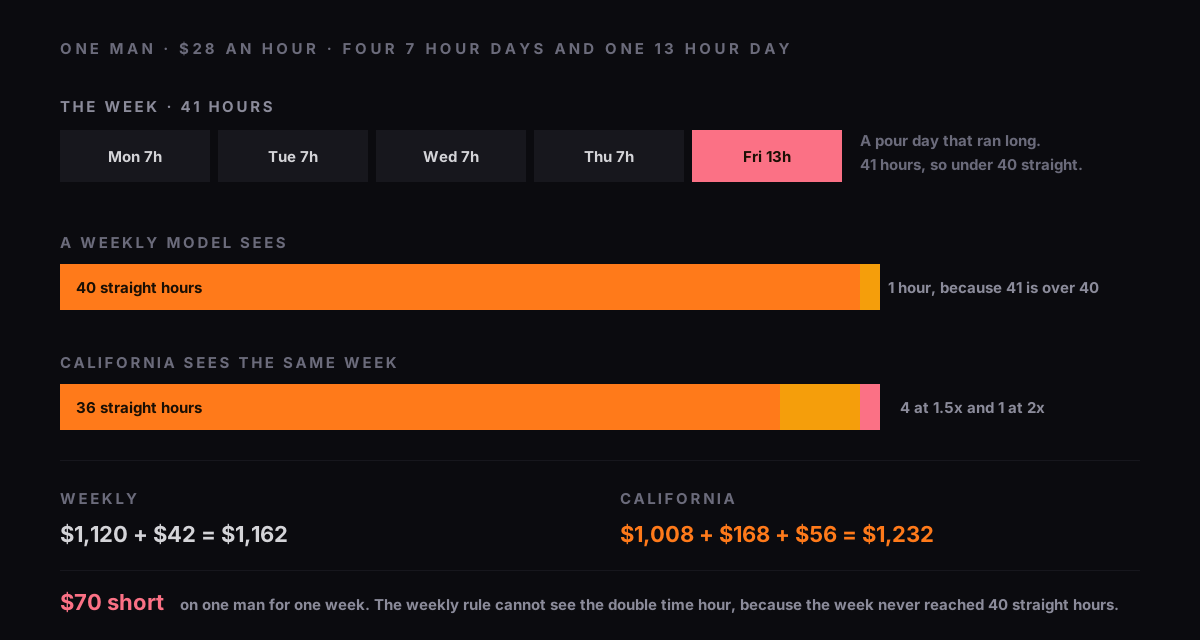
A crew works four days at seven hours and then a pour day that runs to thirteen. Forty-one hours on the timesheet, so a bookkeeper paying weekly overtime sees one hour over forty, pays 40 straight and 1 at time and a half, and moves on.
California pays that week differently: 36 straight hours, 4 at time and a half, and 1 at double time. On one man at $28 an hour the weekly figure is $1,162 and the California figure is $1,232. The weekly model is $70 short on a single week, and it did not miss an hour. It missed a multiplier, because the double time hour only exists on the daily clock.
That is what Labor Code 510 does, and it is the thing a weekly overtime model cannot see. In California the overtime clock is daily. It resets every morning.
The daily rule
| Condition | Multiplier |
|---|---|
| Over 8 hours worked in a workday | 1.5x |
| Over 12 hours worked in a workday | 2x |
| Over 40 straight-time hours in a workweek | 1.5x |
Read the first two again, because they are what a federal model does not have. Eight hours and one minute is time and a half. Not forty hours and one minute. Every day starts again.
Here is a 13 hour pour day at $28 an hour:
| Hours | Rate | Paid |
|---|---|---|
| 8 | straight time | $224 |
| 4 | time and a half | $168 |
| 1 | double time | $56 |
| 13 | $448 |
The double time starts after the twelfth hour, so exactly one hour of that day is at 2x. That is the arithmetic, and on a long pour day it is the difference between the job making its labor line and missing it.
The seventh day is its own rule
If the crew works seven consecutive days in one workweek, the seventh day pays time and a half for the first 8 hours and double time beyond that, whether or not the first six days went over 8 hours.
Seven 8 hour days is 56 hours worked. It pays 40 hours regular and 16 hours at time and a half, which is $1,792 at $28 an hour.
California pays whichever rule produces more, and the two rules diverge in both directions. That is worth seeing side by side, because it explains why a weekly-only model can be wrong without ever being obviously wrong:
| The week | A weekly model pays | California pays | Which is more |
|---|---|---|---|
| Four 7 hour days and one 13 hour day | $1,162 | $1,232 | California, by $70 |
| Five 10 hour days | $1,540 | $1,540 | the same |
| Six 8 hour days | $1,456 | $1,456 | the same |
| Seven 8 hour days | $1,792 | $1,792 | the same |
The daily clock never produces less than the weekly rule, and on the long day it produces more. A weekly-only model cannot generate a double time hour at all, because double time is a daily event, which is why the two agree on every ordinary week and part company exactly when somebody works past twelve hours.
One caution on the clock: the workweek is a fixed seven day period, usually starting Sunday at midnight in the company's timezone. Six days on either side of that boundary is not seven consecutive days, and seven across it is. Getting the boundary wrong changes the payroll.
What counts toward the clock
Travel time. Time the crew spends travelling as part of the job counts toward the day's hours and therefore toward the threshold. Travel is paid at the base rate for the time itself, but it still pushes the day over 8, which is what triggers the premium. Six hours of work plus four of travel is a 10 hour day: 8 straight and 2 at time and a half.
Breaks are paid in California. Meal and rest breaks stay in the hours. A day with an unpaid break deducted is a different day, and deducting one that should have been paid is its own violation.
Minutes, not rounding. Exact times. Rounding to the nearest quarter hour is common practice and it is not what the rule says. On a crew of six over a week, rounding error is real money in both directions.
What pyramiding is, and why it does not apply
The question that comes up most from contractors new to California: if a day is over 8 hours and the week is over 40, does that hour get both premiums?
No. California does not pyramid. An hour already paid as daily overtime comes out of the 40 hour weekly straight-time count, and each hour is paid once at the highest multiplier it earned. A 50 hour week that was ten hours a day is paid as 40 straight and 10 at 1.5, not 40 straight plus 10 daily at 1.5 plus another 10 weekly at 1.5.
Why the daily clock costs money on construction jobs
Construction runs on long days. A pour cannot stop because the clock turned, a finish has to run until it is finished, and a day scheduled for eight hours becomes thirteen without anybody deciding it should.
Ordinary weeks are not where this bites. Five ten hour days is 50 hours, and a weekly model pays 40 plus 10 at time and a half for the same money California requires. Six and seven day weeks are also covered by the weekly rule. The gap is the long day inside a week that never reaches 40 straight hours, and the gap is the multiplier rather than the hours.
That is why it goes unnoticed. The timesheet total is right, the hours are right, and the only thing missing is that one hour of the day after the twelfth, which the weekly rule has no way to produce.
Which means the hours have to be captured on the job, by the clock, on the day they happen. A timesheet filled in on Friday from memory is a guess about four days nobody can reconstruct, and in California a guess about overtime is a wage claim waiting to happen. Our California overtime explainer covers the rest of the rulebook, including prevailing wage days and the alternative workweek.
What to check before the next pay run
- Does the timekeeping split hours per day, not just per week?
- Is the double time threshold at 12 hours in a day, not 12 hours somewhere in the week?
- Does the seventh consecutive day trigger on its own, regardless of the first six?
- Are travel hours in the day's total for the overtime calculation?
- Are breaks paid rather than deducted?
- Is the workweek boundary the one your company actually uses, in your own timezone?
Frequently asked questions
What is the overtime rule in California Labor Code 510? Overtime is measured per workday, not per week. Over 8 hours in a day is time and a half. Over 12 hours in a day is double time. The seventh consecutive day worked in a workweek pays time and a half for the first 8 hours and double time after that. Weekly overtime over 40 straight-time hours is also time and a half.
How is a 13 hour day paid in California? 8 hours at straight time, 4 hours at time and a half, and 1 hour at double time. The double time starts after the twelfth hour, so only the thirteenth hour is at 2x. At $28 an hour that day pays $224 plus $168 plus $56, which is $448.
What is the seventh day rule in California overtime? If a crew works seven consecutive days in one workweek, the seventh day pays time and a half for the first 8 hours and double time for anything after that. It applies whether or not the first six days went over 8 hours. On seven 8 hour days that means 40 regular hours and 16 at time and a half.
Does travel time count toward California overtime? Time your crew spends travelling as part of the job counts toward the day's hours and therefore toward the overtime threshold. Travel counts at the base rate for the time itself but still pushes the day over 8, which is what triggers the premium. Confirm the specifics with your payroll professional.
Is California overtime different from federal overtime? Yes, and the difference is the whole point. Federal law under the FLSA pays overtime only after 40 hours in a workweek. California adds a daily clock on top: over 8 hours in a day and over 12 hours in a day both trigger premiums regardless of the weekly total.
What is pyramiding in California overtime? Pyramiding is paying the same hour twice at two different rates. California does not pyramid: an hour already paid as daily overtime is excluded from the 40 hour weekly straight-time count, and each hour is paid once at the highest multiplier it earned.
General information for contractors, not legal advice. The rules above reflect California Labor Code section 510 and the Industrial Welfare Commission wage orders. Confirm how they apply to your own crews and pay periods with a payroll professional or employment counsel before you run payroll.