[ Blog ]
How to Price a Paver Patio So You Actually Make Money
September 15, 2026
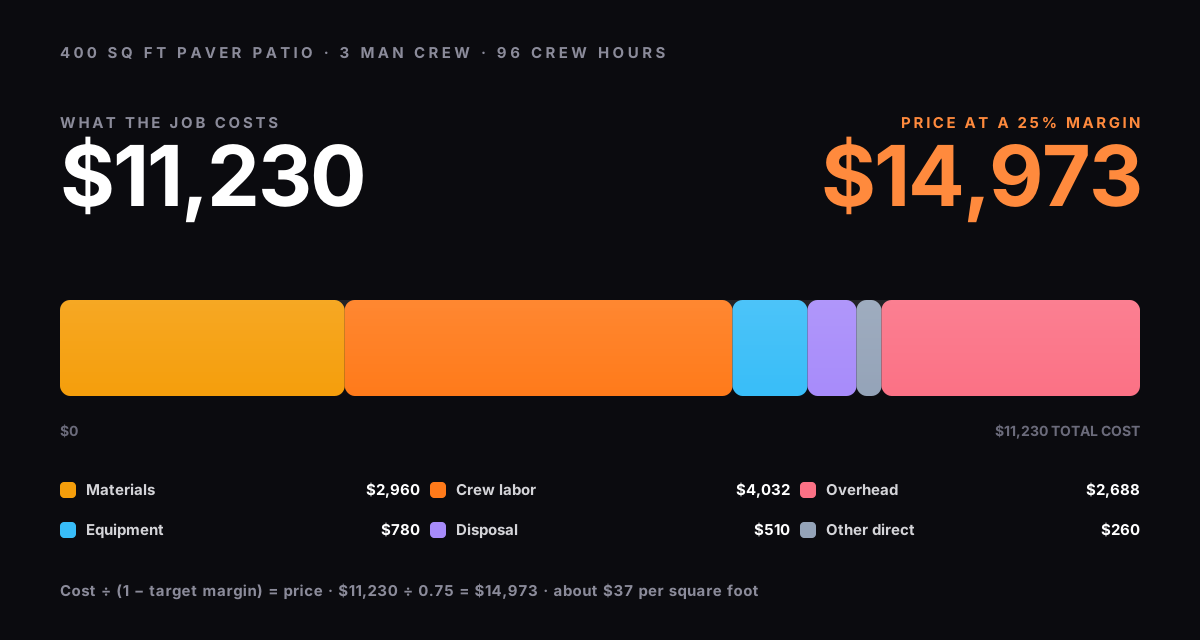
A hardscaper bids a 400 square foot paver patio at $32 a square foot, wins it, finishes it, and finds out months later that it made almost nothing. The price was not the problem. The problem was the six inches underneath the pavers, the twelve cubic yards of spoil nobody measured, and ninety six crew hours that were estimated from memory.
Per-square-foot pricing is not wrong because the number is wrong. It is wrong because it is an output. You cannot know the number until you have built the cost underneath it, and on hardscape work that cost moves more than it does in almost any other trade.
The square foot number is the last thing you should calculate
Two patios can both be 400 square feet and differ by four thousand dollars in cost:
- Access. A back alley and a gate wide enough for a machine, or a narrow side yard where every bucket of base and every paver bundle moves by hand.
- Spoil. Excavating 6 inches and removing it, or 10 inches with clay that has to be hauled 30 miles.
- Base depth. 4 inches of compacted base on stable subgrade, or 8 inches with geotextile and a drainage solution because the yard holds water.
- Cuts and layout. A simple rectangle, or a herringbone field with a curved border and 40 feet of saw cuts.
- Season. A July pour of a schedule, or November work where a weather day costs you a full crew.
The per-foot figure is where the estimate ends up. It is not where it starts.
That is also why published averages are a trap. Consumer cost guides put paver patio installation at $8 to $25 per square foot, with a 280 square foot patio averaging about $3,400 (BobVila). Those figures blend the easy jobs with the hard ones. You are about to build one specific job, and it is either easier or harder than the blend.
The six cost lines that decide whether the patio makes money
1. Excavation and haul-off, measured in cubic yards. Volume is area times depth, then bulked because spoil fluffs up when you dig it. A 400 square foot patio with 6 inches of excavation and over-excavation for base is roughly 7.4 cubic yards in place, about 9 to 10 cubic yards once it is in the truck. At $50 to $60 a yard for disposal, that is $500 gone before a single paver is laid. Most bids never include it.
2. Base and bedding at compacted depth. Order material for the compacted depth, not the loose depth, and use your supplier's real density. Six inches of compacted base across 400 square feet is about 10 tons of crushed stone. Bedding sand adds another inch and a half to two tons.
3. Pavers at delivered cost, plus waste. Basic pavers run $3 to $6 per square foot for material, and laying labor adds roughly $3 to $4 per square foot on a simple layout (HomeAdvisor). Order 5 to 7 percent waste on a simple field, 10 percent on diagonal or heavily cut layouts. Waste is not optional and it is not free: 400 square feet at $4.10 a foot is $1,640, and the 28 extra square feet you will actually use is another $115.
4. Burdened crew labor, not wages. A $28 an hour installer costs you closer to $42 an hour once you add payroll taxes, workers comp, general liability and paid time. On a 96 hour job that difference is $1,344, which is nine percent of the price, and it is the single most common reason a hardscape job "should have made money."
5. Equipment, truck time and fuel. Plate compactor, mini excavator or walk-behind, delivery, and the truck hours between the yard, the supplier and the site. Hardscape work is material-heavy, so truck time is a real cost line, not overhead.
6. Overhead per crew hour. Add up a year of overhead (insurance, office, software, trucks, yard, tools, your own salary if you pay yourself) and divide it by a year of billable crew hours. That gives you a rate to charge to every estimated hour. If it is $28, a 96 hour job carries $2,688 of overhead whether you charged for it or not.
A 400 square foot paver patio, costed line by line
| Line | Basis | Cost |
|---|---|---|
| Crushed base | 10 tons delivered at $52 | $520 |
| Bedding sand | 1.6 tons at $45 | $75 |
| Pavers | 428 sq ft (7% waste) at $4.10 | $1,755 |
| Edge restraint | 90 linear feet at $3.10 | $280 |
| Polymeric sand | 5 bags at $42 | $210 |
| Geotextile and misc | allowance | $120 |
| Crew labor | 96 crew hours at $42 burdened | $4,032 |
| Equipment | compactor, excavator, delivery, fuel | $780 |
| Disposal | 9.5 cubic yards at $54 | $510 |
| Other direct | small tools, blades, fuel, permit | $260 |
| Overhead | 96 hours at $28 | $2,688 |
| Total cost | $11,230 | |
| Price at 25% margin | $11,230 ÷ 0.75 | $14,973 |
That works out to about $37 per square foot, which is deliberately above the published $8 to $25 average: this is a full-scope build with six inches of compacted base, excavation, haul-off and polymeric sand. If your market will not pay it, remove scope or decline the job. What you must not do is bid the published average and then deliver this.
If your number lands at $22 a foot on this job, you have missed a line above. If it lands at $60, check your production rates before you conclude the market will not pay it.
What happens when you price the same job at $30 a square foot
$30 a square foot is $12,000. Against $11,230 of cost that is $770 of margin, or 6.4 percent:
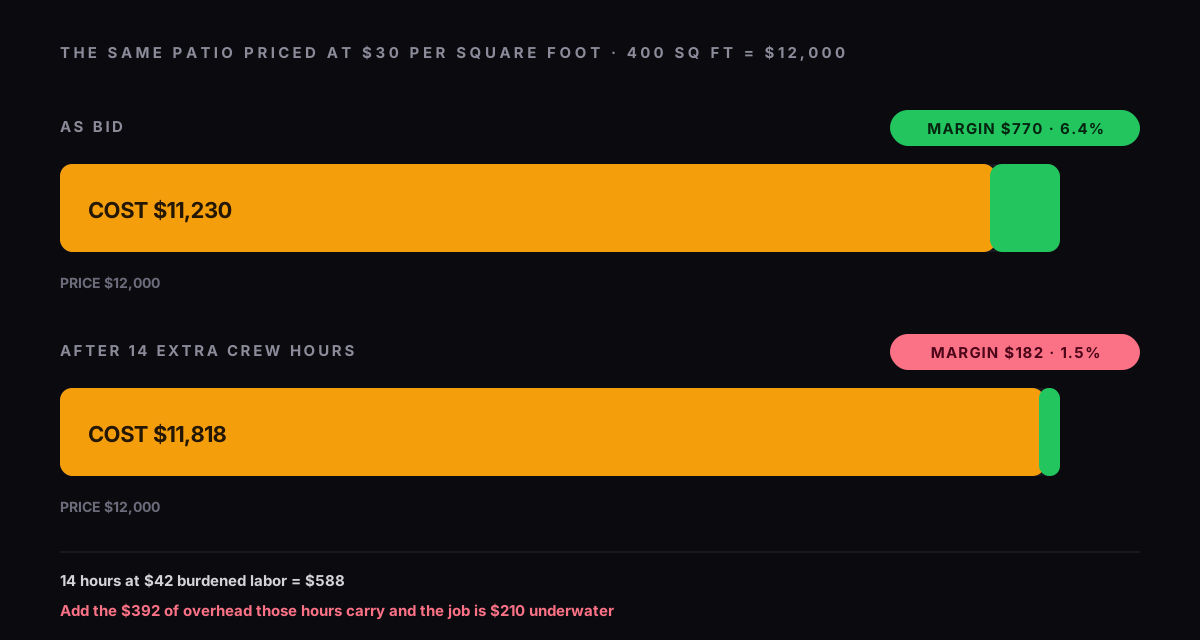
Now let the job behave like a real job. A rainy Tuesday costs a day, and a drainage surprise adds a day of digging and stone:
- 14 extra crew hours at $42 is $588, and it also carries $392 of overhead.
- Cost moves to $12,210.
- The $12,000 price is now $210 underwater.
That is the entire risk of per-foot pricing in one number. You did not lose the job because you were underbid. You lost it because a $770 cushion cannot absorb a normal week of hardscape reality.
Three habits protect you:
- Price from cost, then check the per-foot number. Use the Job Costing Calculator to build the cost and the Markup Calculator to convert margin into markup correctly. Adding 25 percent to cost is not a 25 percent margin; it is 20 percent. To hit 25 percent you divide by 0.75.
- Put a weather and access allowance in the bid or a clear clause that names what triggers a change order.
- Track hours by phase on the next three jobs. Estimated hours are opinions. Tracked hours are prices.
Production rates to plan with
| Phase | Planning range |
|---|---|
| Excavation and spoil loading | 90 to 120 sq ft per crew hour |
| Base placement and compaction | 120 to 160 sq ft per crew hour |
| Screeding bedding | 200 to 300 sq ft per crew hour |
| Laying pavers (modular field) | 60 to 100 sq ft per crew hour |
| Cuts, edge restraint and borders | 30 to 50 linear feet per crew hour |
| Polymeric sand and cleanup | 200 to 300 sq ft per crew hour |
Those ranges produce the 90 to 110 crew hours used above. Treat them as a starting point for planning, not as your rates, because they change with crew skill, layout complexity, paver size and access. The only production rate that should drive your bids is the one your own crew produces, measured with GPS time tracking by phase and by job.
The loop that makes the next bid better
The bid is a hypothesis. Job costing is how you find out whether it was right, and the difference between a hardscape company that grows and one that plateaus is whether anyone closes that loop.
Here is the rhythm that works for crews your size:
- Bid from the cost stack and record the estimated hours by phase.
- Track actual hours and material by job, including change orders, so the comparison is honest.
- Compare at the end of every job. Not at the end of the year. Weekly if the job runs longer than two weeks.
- Update one production rate. Not all of them. The phase you missed by the most.
- Repeat. After five jobs your bids stop being guesses.
If you want the full method behind that loop, start with Construction Job Costing: The Complete Guide, then How to Calculate Construction Job Costs for the bid-side math.
Your next hardscape bid, in order
- Measure the area and the depth, and write down access, drainage and obstructions.
- Calculate spoil volume in cubic yards, bulked, and price the disposal.
- Calculate base and bedding at compacted depth, at delivered cost.
- Price pavers with waste, plus edge restraint and polymeric sand.
- Estimate crew hours by phase using your own rates where you have them.
- Apply burdened labor, equipment, truck time, other direct costs and overhead.
- Divide cost by one minus your target margin. Then look at the per-foot number as a sanity check.
- Send it as a proposal the homeowner can sign, and put your change order process in writing before you start.
Where these numbers come from
- Paver patio installed cost, averages and high-end ranges: BobVila, citing Angi and HomeAdvisor data.
- Paver material and laying labor per square foot: HomeAdvisor walkway and patio costs.
- The worked example above is illustrative arithmetic, not a quote: material prices, crew hours, burdened rate and overhead are stated so you can substitute your own.
SiteOps builds that cost stack into every job as it runs. Your crew clocks in with GPS on the free crew app, hours roll into burdened labor automatically, receipts and material costs attach to the job, and you can see whether the patio is still on margin before you are standing on finished pavers wondering what happened. Start a free trial and put one live job in it this week.