Markup vs Margin: The Difference Costs You a Job a Year
October 6, 2026
There is a mistake that shows up in every pricing thread in the trade, and it costs a shop about one job a year.
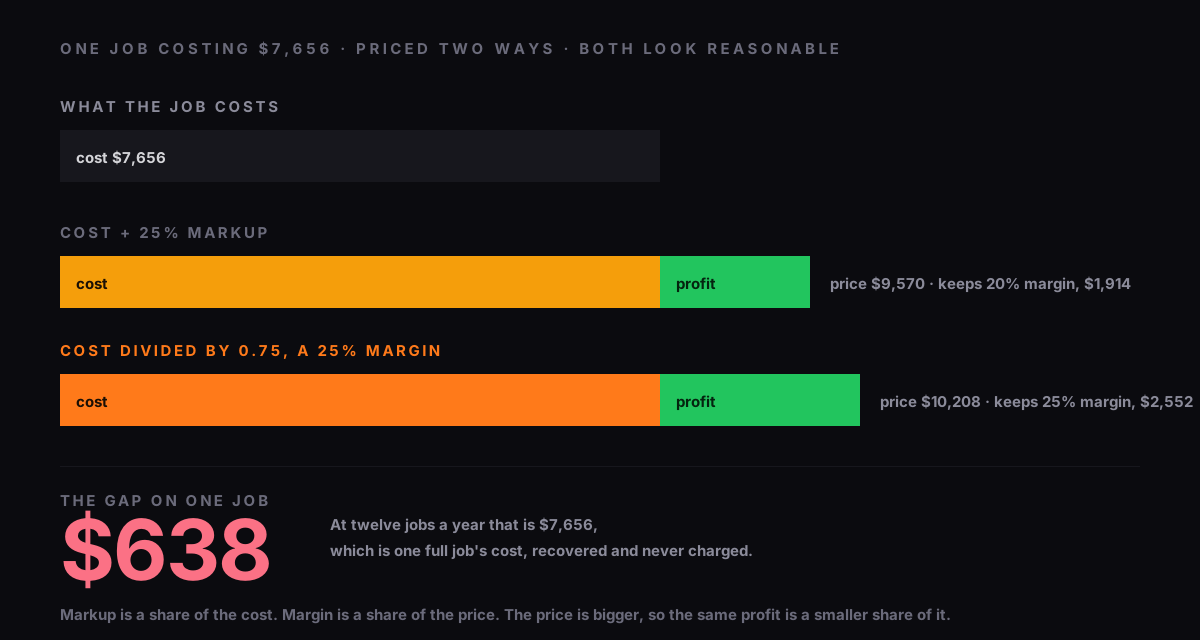
A contractor has a job that costs $7,656 to build. He wants to keep 25 percent, so he adds 25 percent: $7,656 times 1.25 is $9,570. He sends the bid. The job runs, and at the end he finds he kept 20 percent, not 25.
He lost $638 on that job without anything going wrong. The crew showed up, the pour went well, the customer paid. The number was just wrong in the same direction as everybody else's.
The difference, in one line
Markup is measured against your cost. Margin is measured against your price. The price is bigger than the cost, so the same profit is a smaller share of it.
- $7,656 of cost, priced at $10,208, is a 25 percent margin and a 33.3 percent markup
- $7,656 of cost, priced at $9,570, is a 20 percent margin and a 25 percent markup
Both of those are real prices. Only one of them keeps a quarter.
The conversion, both ways
Margin to markup: divide the margin by one minus the margin.
25% margin -> 0.25 / (1 - 0.25) = 0.25 / 0.75 = 33.3% markup
Markup to margin: divide the markup by one plus the markup.
25% markup -> 0.25 / (1 + 0.25) = 0.25 / 1.25 = 20% margin
And the one that matters when you are pricing: divide the cost by one minus the margin.
$7,656 / 0.75 = $10,208
Never multiply the cost by anything. The division is the whole trick.
What every margin looks like as a markup
On the same $7,656 job:
| Margin you keep | Price | That is a markup of |
|---|---|---|
| 20% | $9,570 | 25.0% |
| 25% | $10,208 | 33.3% |
| 30% | $10,937 | 42.9% |
| 35% | $11,778 | 53.8% |
| 40% | $12,760 | 66.7% |
Look at the shape of that table. A 20 percent margin is only a 25 percent markup. A 40 percent margin is a 67 percent markup. The gap widens as the margin grows, which is why the mistake is worst on the jobs where you were trying hardest to make money.
The 50 percent that is really 33
The version of this that catches experienced contractors is the halfway point.
A 50 percent markup on $7,656 is $11,484. The profit is $3,828. As a share of that price, $3,828 is 33.3 percent, which is a third and not a half.
To actually keep 50 percent, the price is $7,656 divided by 0.5, which is $15,312. That is a 100 percent markup on cost, and it is nearly four thousand dollars more than the markup version.
If you have ever said "I mark everything up 50 percent" and wondered why the margins never look like 50, that is why. You were reading two different numbers and calling them the same thing.
What it costs over a year
Back to the $638.
At twelve jobs a year, the gap is $7,656. That is one full job's worth of cost, recovered every year and never charged for. Not a fee, not a lost bid, not a bad debt. Just a number that was one operation away from right.
And it compounds with every job you price. A shop doing forty jobs a year at that scale is giving away more than three jobs annually to a conversion it never ran.
Why the trade talks about it this way
Worth knowing where the confusion comes from, because it is not stupidity. Suppliers quote markup. A material house says "we mark it up 30 percent," and that is correct for what they mean. Your books report margin. Your accountant, your P&L and your bank all talk about gross margin, which is a share of revenue.
So a contractor moves between two vocabularies all day, and both are correct in their own context. The error is using one number in the other's place, and it is invisible because both produce a plausible price.
How to stop making it
1. Write both numbers on the estimate. The contractor markup calculator shows the margin and the markup for any pair, and the gap is right there.
2. Price by division, never by multiplication. Cost divided by one minus the margin. If you take one habit from this page, take that one.
3. Check the finished job. What you set and what you kept are different numbers. Our profit margin post walks the six steps from price to actual margin, and the complete guide covers the cost lines underneath it.
4. Know your own number before you need it. Work out what margin your shop needs once, write it down, and stop recalculating it under time pressure on a bid.
Frequently asked questions
What is the difference between markup and margin? Markup is measured against your cost. Margin is measured against your price. A 25 percent margin is a 33.3 percent markup on the same job, and a 25 percent markup is only a 20 percent margin. They are two names for two different numbers, and adding one when you meant the other always leaves you short.
How do I convert markup to margin? Divide the markup by one plus the markup. A 25 percent markup is 0.25 divided by 1.25, which is a 20 percent margin. To go the other way, divide the margin by one minus the margin: a 25 percent margin is 0.25 divided by 0.75, which is a 33.3 percent markup.
How do I price a job to keep a 25 percent margin? Divide the cost by one minus the margin. On a job costing $7,656, that is $7,656 divided by 0.75, which is $10,208. Adding 25 percent to the cost instead gives $9,570, which only keeps 20 percent.
Why does a 50 percent markup only give a 33 percent margin? Because markup is a share of the cost and margin is a share of the price, and the price is bigger than the cost. On a $7,656 cost, a 50 percent markup is $11,484, and the profit of $3,828 is 33.3 percent of that price, not 50 percent.
How much does the markup and margin mistake actually cost? On a $7,656 job, the difference between a 25 percent margin and a 25 percent markup is $638. At twelve jobs a year that is $7,656, which is one full job's worth of cost recovered and never charged.
Which one should I use when pricing a job? Set the margin, because margin is the number you keep and the number your books report. Then check the markup it equals so the number matches how your market talks. Price with cost divided by one minus the margin, never cost plus a markup.
General information for contractors, not accounting, tax, or legal advice. The figures are a worked example with stated assumptions, not market rates for your area. Confirm your own cost, overhead and target margin against your books before you price work.