How Many Yards of Concrete Do I Need?
September 21, 2026
Concrete is ordered in cubic yards, and a cubic yard is a box three feet on every side. Everything else is multiplication. That is the whole formula, and most of the calls that go wrong are not arithmetic mistakes, they are one of two shortcuts.
The formula
Length in feet, times width in feet, times thickness in feet, divided by 27.
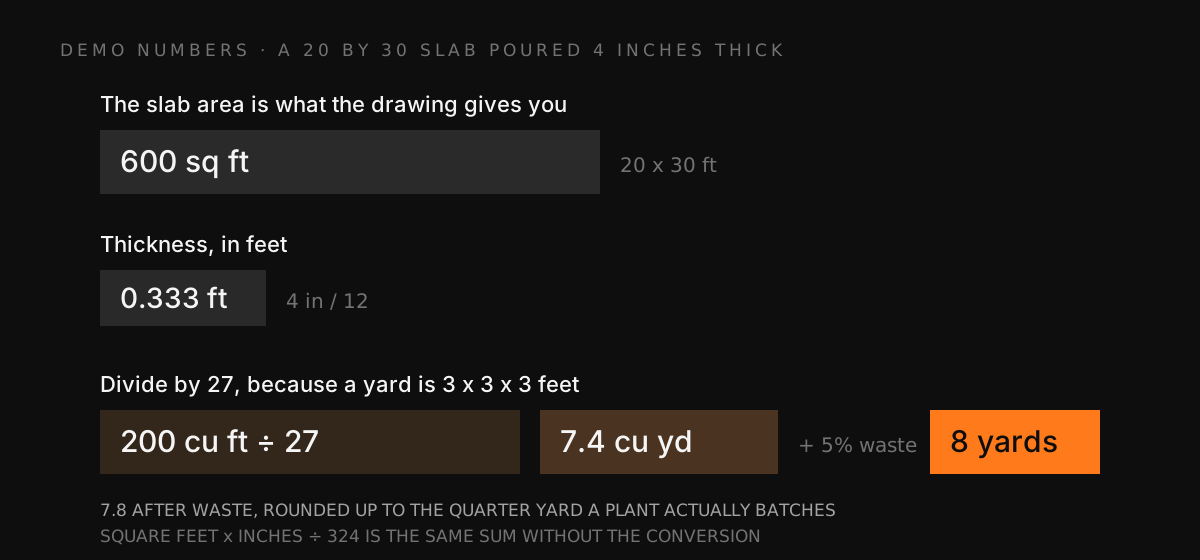
A 20 by 30 foot slab, 4 inches thick:
- 20 x 30 = 600 square feet
- 4 inches is 0.333 feet
- 600 x 0.333 = 200 cubic feet
- 200 / 27 = 7.4 cubic yards
If you would rather not convert the thickness, square feet times thickness in inches divided by 324 gives the same answer, because 324 is 27 times 12. Both are the same sum wearing different clothes.
The waste factor, and why you should not skip it
Nobody pours the drawing. The subgrade is never perfectly flat, the slab is a little thicker where it meets the forms, concrete sticks to the chute and the wheelbarrow, and the last yard of the truck is never quite the last yard.
Five percent is the working number for flatwork on subgrade you prepared yourself.
Ten percent is the honest number when any of these is true: the subgrade is rough or uneven, the slab has thickened edges or a turned-down perimeter, the forms were set by hand and the depth wanders, or the pour has to be finished in one pass with no cold joint allowed.
On the 20 by 30 slab, 5 percent takes 7.4 to 7.8 yards. Then round up to what the plant batches, which is usually a quarter yard, so the order is 8 yards. The quarter-yard rounding is what turns 7.77 into 8, and that is the point of doing it on paper rather than in your head at the counter.
The first shortcut that costs you money
Ordering to the exact number.
Running short mid-pour is the single most expensive thing on this page. A short load means either a second truck with its own short-load fee, or a cold joint where the first pour stopped, or a crew standing in wet concrete waiting while the clock runs. Compare that with the cost of half a yard you did not strictly need and the arithmetic stops being close.
The reverse has a trap of its own. An extra yard you cannot use is a hole in the ground, or a pile that sets in the driveway and gets broken up with a sledgehammer on Monday. So the wasted yard is not free either. Order to the waste factor and the batch size, not to the drawing, and not to a guess.
The second shortcut: pricing the slab off the yardage
This is the one that costs more than half a yard, and it is the reason to do the yardage properly in the first place.
Concrete is the easy line to see. It is also rarely the biggest one. On a worked driveway in our concrete job costing post, the delivered concrete is about 29 percent of the cost, and the lines that get skipped are labor at the loaded rate plus an overhead share. Calculated at the wrong thickness, a yardage error also walks straight into the bid, because every quantity downstream of the slab thickness moves with it.
Price the yardage first, then price the rest of the job on top of it. The concrete bid calculator does that in order, and it starts from the same yardage formula above.
Do it in one step
The concrete bid calculator takes the yardage and carries it into the money: delivered concrete, base, rebar, forms, pump, crew labor at the loaded rate, an overhead share, and your margin. Start with the quantity from this page, then price the rest of the job on top of it.
A dedicated quantity calculator is being built, and when it lands it will do just the conversion with a waste factor and a batch round-up. Until then, the formula above is the whole thing.
Questions people ask
What is the formula for cubic yards of concrete?
Length in feet times width in feet times thickness in feet, divided by 27. A 20 by 30 foot slab at 4 inches is 600 square feet times one third of a foot, which is 200 cubic feet, which is 7.4 cubic yards.
How many yards of concrete do I need for a 30 by 30 slab?
At 4 inches it is 11.1 cubic yards before waste. With 5 percent waste it is 11.7, and most plants batch in quarter yards, so the order is 11.75 yards.
How much waste should I add to a concrete order?
Five percent is the working number for flatwork on prepared subgrade, and ten is safer when the subgrade is uneven, when there are thickened edges, or when the forms are hand set and the depth wanders. Then round up to the batch size.
How many square feet does a yard of concrete cover?
A cubic yard covers 324 square feet at one inch thick, 108 square feet at 3 inches, 81 square feet at 4 inches, and 54 square feet at 6 inches. Divide 324 by the thickness in inches and that is the coverage.
Why did my concrete order come up short?
Four causes, in order of how often they happen: the subgrade was not as flat as it looked, the slab was thicker than the drawing at the edges, the forms spread under the pour, and the waste factor was left at zero. Any one of them can eat half a yard on a small slab.
Do I order concrete in yards or in meters?
In the United States concrete is ordered in cubic yards and batched in quarter yards. Outside the US it is usually cubic meters, so convert at 1 cubic meter equals 1.308 cubic yards.
General information, not engineering advice. Structural slabs, footings and anything under a load need an engineer's drawing and a thickness you did not choose yourself.