What to Charge for Concrete Work
September 28, 2026
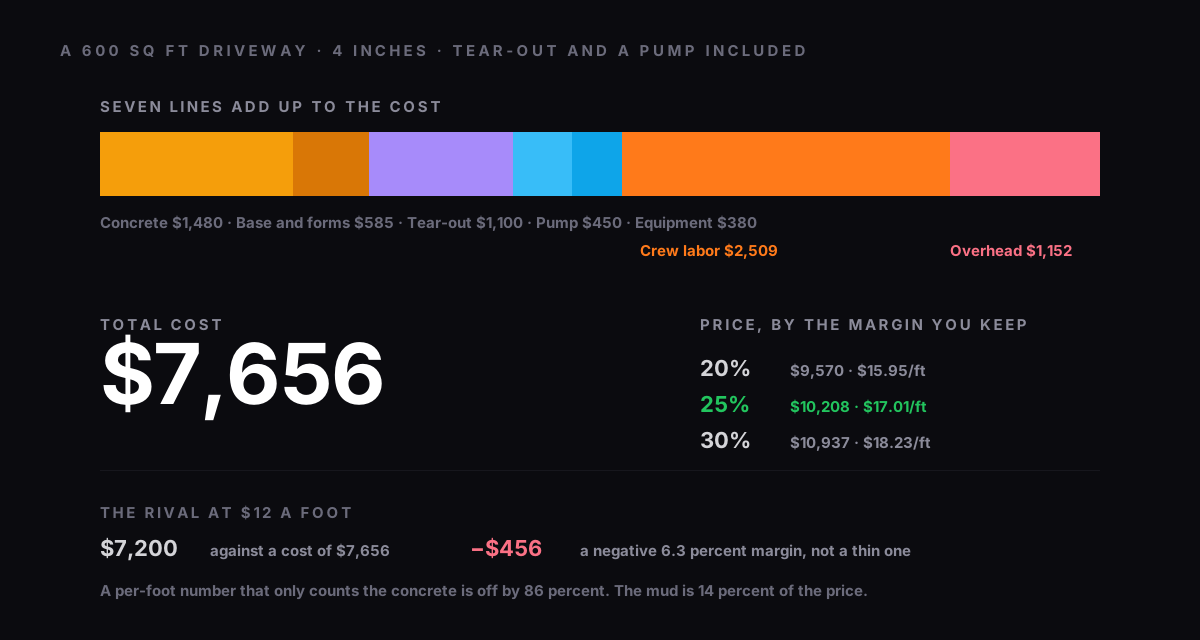
A concrete contractor quotes a 600 square foot driveway at $12 a square foot, because that is roughly what the other two bids came in at and it is what the customer says they were expecting. He wins the job. He pours it, strips the forms, and finds out at the end of the month that the job cost him $7,656 and paid him $7,200.
He did not lose the job because he was underbid. He lost it because he started from a per-foot number instead of from his own cost, and a per-foot number cannot see a pump, a haul-off, or labor at anything other than the wage.
Here is the cost stack under that driveway, what it prices at on a real margin, and where the number on the phone should actually come from.
Why the per-foot number is the wrong place to start
Two 600 square foot driveways can differ by four thousand dollars in cost. One is a repour on prepared grade with the truck able to back up to the forms. The other has six inches of tear-out, a side yard the truck cannot reach, and a pump.
Both are 600 square feet. The foot price is the same and the cost is not. That is the whole problem with quoting from it.
The concrete is the easy line to see and it is rarely the biggest one. On the example below, the mud is 14 percent of the price. Everything else is base, tear-out, haul-off, a pump, equipment, crew labor and overhead, and a per-foot number that only counts the concrete is off by 86 percent.
So the order is: build the cost, decide the margin, and let the per-foot figure fall out at the end as a check against your market. Never the other way round.
The seven lines under a concrete job
This is the same structure our concrete bid walkthrough builds step by step. On a 600 square foot driveway at 4 inches, with tear-out and a pump, it comes to this:
| Line | Basis | Cost |
|---|---|---|
| Concrete | 8 yards at $185 delivered | $1,480 |
| Base rock and forms | $585 | |
| Tear-out and haul-off | subcontracted | $1,100 |
| Pump | $450 | |
| Equipment and rentals | saw, compactor, fuel | $380 |
| Crew labor | 64 hours at $39.20 burdened | $2,509 |
| Overhead | 64 hours at $18 | $1,152 |
| Total cost | $7,656 |
Two lines there are the ones that go missing. Labor at $39.20 is not the wage, it is the wage plus payroll taxes, workers comp, liability and paid time. And the overhead line is the job's share of the shop, the trucks and the insurance, charged at a rate per crew hour.
Together those two are $3,661, or 48 percent of the entire cost of the job. Leave them out and the job cannot make money at any price. That is covered in full in our job costing guide.
What that prices at
Now the margin. Divide the cost by one minus the margin you want to keep.
| Margin | Price | Per square foot | Profit |
|---|---|---|---|
| 20 percent | $9,570 | $15.95 | $1,914 |
| 25 percent | $10,208 | $17.01 | $2,552 |
| 30 percent | $10,937 | $18.23 | $3,281 |
That is the number you quote. Not $12 a foot, and not a foot price at all until you have checked it against your market.
What a $12 a foot rival actually means
Here is the arithmetic that decides the job.
At $12 a square foot on 600 square feet, the price is $7,200. The cost is $7,656. Matching that price does not leave you a thin margin. It leaves you $456 short, which is a negative 6.3 percent margin.
So when a competitor is at $12 a foot on a job like this one, one of three things is true, and it is worth knowing which before you move your number:
- They are buying the work. They will find out at the end of the month, the same way you would have.
- They are not building the same job. No tear-out, no pump, no haul-off, concrete on prepared grade the builder paid for. That is a different product at a different price, and it is not a competitor to yours.
- They have a lower cost than you, and it is worth finding out where. Better plant pricing, a crew that finishes faster, or equipment you are renting and they own.
None of those three is a reason to match the price. Recheck your seven lines, then hold your number.
Margin is not markup, and this is where it goes wrong
The most common mistake in concrete pricing is adding a markup and calling it a margin.
- $7,656 plus 25 percent markup is $9,570. That is a 20 percent margin, not 25.
- To keep 25 percent you divide by 0.75, which gives $10,208.
The difference is $638 on one driveway, and it is invisible on the quote because both look like a reasonable price. The contractor markup calculator shows the gap for any pair of numbers, and the profit margin post walks the conversion.
Before you quote the next one
- Is every one of the seven lines on the quote, including burdened labor and the overhead share?
- Is the price the cost divided by one minus the margin, not cost plus a markup?
- Do you know which of the three things a cheaper rival is doing before you move your number?
- Is the per-foot figure a check on the price, or was it the thing you started from?
- Are the exclusions named, so a pump or a haul-off is a change order rather than a loss?
Every one of those is a line of writing or a line of arithmetic. None of them is luck.
Frequently asked questions
How much should I charge for concrete work? Build it from cost, then divide by one minus your margin. On a 600 square foot driveway with tear-out, a pump and haul-off, the cost is $7,656. At a 25 percent margin the price is $10,208, which is $17.01 a square foot. A 30 percent margin gives $10,937, or $18.23 a foot.
What is concrete pricing per square foot in 2026? It depends entirely on what the foot includes. The concrete material alone on our example is $2.47 a square foot. The same job priced to keep 25 percent is $17.01 a foot. Both are true, and only one of them is the job.
Why is a $12 per square foot concrete price a loss? Because on a full-scope job it is below cost. Our 600 square foot example costs $7,656 to build. At $12 a foot the price is $7,200, which is $456 less than the cost. That is not a thin margin, it is a loss, and you find out when the job closes.
What is the difference between margin and markup on concrete? Markup is measured on cost, margin is measured on the price. On a $7,656 cost, adding 25 percent markup gives $9,570, which is a 20 percent margin, not 25. To keep 25 percent you divide by 0.75 instead of multiplying by 1.25.
What costs do concrete contractors forget to price in? Crew labor at the burdened rate rather than the wage, the overhead share, the pump, haul-off and disposal, and equipment. On our example the labor burden and the overhead together are $3,661, which is 48 percent of the whole cost, and both are commonly left out.
Should I give a per square foot price to a customer asking on the phone? Give a range with the exclusions named, or go and look at it. A per-foot number quoted before anyone has seen the subgrade, the access or the tear-out is a number you will be held to and cannot see the cost behind.
General information for contractors, not accounting, tax, or legal advice. The dollar figures are a worked example with stated assumptions, not market rates for your area. Confirm your own burden, overhead and plant pricing before you price work.