[ Blog ]
How to Bid a Concrete Job
September 14, 2026
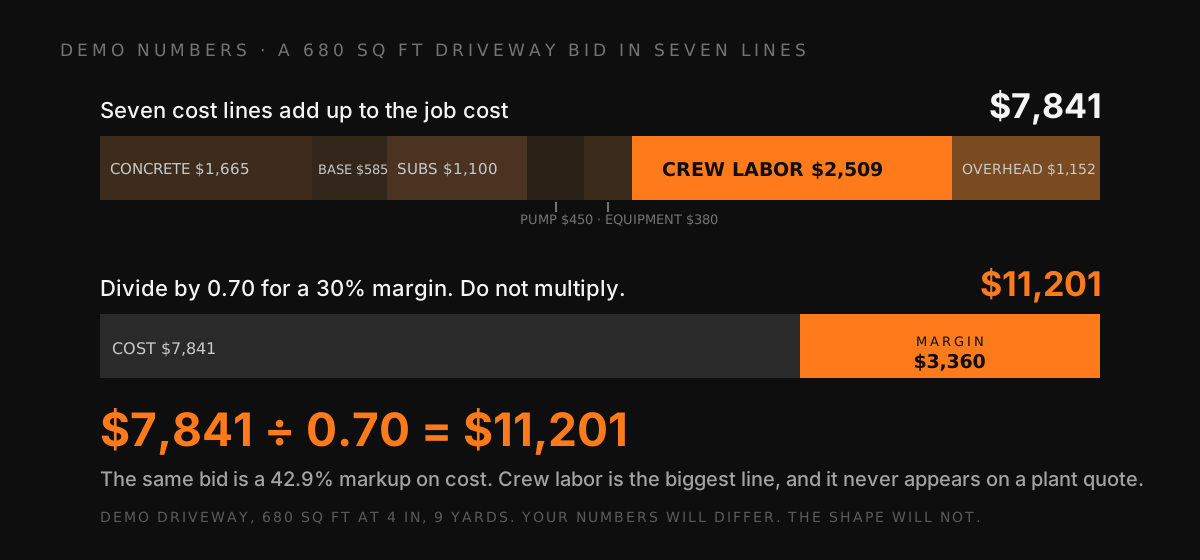
To bid a concrete job, start with the scope. Figure the yards. Price the concrete as it will arrive on the ticket. Add every line that is not the mud, then crew labor at the loaded rate, then an overhead share. Divide the total by one minus your target margin. That number is the bid price. Divide it by the slab area and you have your per-foot number, which is a check, not a starting point.
This post walks the whole bid on one worked driveway. The numbers are the demo job our Job Costing for Concrete Contractors post costed after the fact. They are also the defaults in the free Concrete Bid Calculator, so you can follow along or type your own numbers as you go.
Every dollar figure below is demo math for illustration, not a market rate.
Step 1: Write the scope before you write a number
Plenty of bad concrete bids are not math errors. They are scope errors. The number was right for the job you pictured and wrong for the job you poured.
Write down, in the bid, what you are pouring and what you are not:
- square footage, thickness, and finish
- tear-out and haul-off, or none
- base depth, rebar or mesh, and control joints
- thickened edges, aprons, and curbs
- who grades and who pulls the permit
- where the truck parks and whether a pump is in the price
Then write what is excluded.
Two cautionary tales from the forums. A Texas concrete company quoted a driveway demo and repour "to the property line." The homeowner expected it to reach the street, then expected four sections and redwood joints, none of which were in the quote. They gave three price reductions over the mix-up and later paid for a core test when she claimed the slab was thin. It came back thicker and stronger than quoted. Their own account is on Levelset's payment help board from 2022. And a sub on a drilled-pier job told Heavy Equipment Forums in 2024: "lost my shirt on some fine grading that lost equipment acess and needed to be done by hand and i didnt get the detail for it in the contract" (typos his). His full post is here. Both jobs were priced for the scope on paper. The paper was the problem.
Step 2: Figure the yards
Concrete yardage is area times thickness, in cubic yards. Take square feet, multiply by the thickness in feet, and divide by 27.
The demo driveway is 680 square feet at 4 inches. That is 680 × 4 ÷ 12 ÷ 27, about 8.40 yards. Add waste, then round up to what your plant will batch. At 5 percent waste that is 8.81 yards, and the next quarter yard up is 9.00. So the order is 9 yards.
Five percent is a placeholder, not a rule. Uneven subgrade, thickened edges, hand-formed curbs, and a low spot the grader missed all eat more than the flat math shows. If the plant batches in half or whole yards, round to that instead. The calculator's yardage helper does the arithmetic and shows every step so you can check it on your phone.
Step 3: Price the concrete as delivered
The per-yard number on the plant quote is where the concrete line starts, not where it ends. A Central New York mason listed his 2011 ticket in one line: "Right about $100 a yard. Plus tax, plus fuel surcharge, plus short load fee......." (his ellipsis, his 2011 prices). The shape of that sentence has not changed. Whatever your plant bills beyond the per-yard price, put it in the bid in advance.
On the demo, 9 yards at a $185 placeholder quote is $1,665. The demo carries $0 in truck fees. A Heavy Equipment Forums poster wrote in 2009 that his plant had a "5 yard min." with a "$50 partial charge" under it, at 2009 prices. Nine yards clears a line like that. Your ticket may not. If your plant bills a surcharge, tax, wait time, or a small-load charge, that money goes on the job that ate it. Price it before the truck rolls.
Step 4: Everything that is not the mud
Four more lines, each off a real quote or receipt:
- Base, rebar, forms, and cure. Base rock, rebar or mesh, form lumber and stakes, expansion joint, cure and seal. Demo: $585.
- Subs. Tear-out and haul-off, grading, a finishing crew if you bring one. Demo: $1,100 for the haul-off sub.
- Pump. The pump company invoice, if the truck cannot chute it. Demo: $450.
- Equipment and rentals. Saw, plate compactor, trowel machine, blades, fuel, and the small stuff like dump fees and the permit if you carry it. Demo: $380, the saw and compactor rental.
Price the hard parts on their own line instead of letting a foot price swallow them. A foundation sub on r/Concrete wrote in 2024 that "I feel like I'm losing money whenever we do stairs. I like to give this guy a good price, but stairs take a lot of time to form and finish." He was pricing stairs inside a labor-only rate and could not see them. A separate line would have.
Step 5: Crew labor at the loaded rate, not the wage
Crew labor is the biggest line on the demo. It is also the line that goes wrong most often in the threads we read, because the bid used the wage instead of the loaded cost.
Loaded cost is the wage plus everything that rides on it: payroll taxes, workers comp, liability insurance, time off. Workers comp on concrete crews tends to run steep, so check your own rate before you bid off bare wages. The burden math is in the Complete Guide to construction job costing.
Demo: four men, sixteen hours each across form, pour, finish, and strip, is 64 crew hours. At a $28 average wage with 40 percent burden the loaded rate is $39.20, so crew labor is $2,509. If pour day brings extra finishers, count their hours too. On paper, add every hour. In the calculator, divide total man-hours by crew size and type that into the hours-per-man box so the product comes out right.
Step 6: Add the overhead share
Overhead is the shop, the trucks, the insurance, the estimating nights, and the phone bill. Every job carries a piece of it or the company quietly eats it.
The simplest method for concrete work is a rate per crew hour. Take a year of overhead and divide it by the field hours you charge to jobs, not every paid hour. Demo: say $64,800 of yearly overhead over 3,600 field hours is $18 per crew hour. $18 × 64 hours = $1,152. The full list of what belongs in a job cost, for any trade, is in How to Calculate Construction Job Costs. A per-hour rate recovers nothing on material and subs, so if your work is material heavy, the percent-of-cost method in the Job Costing Calculator fits better. Either method beats no line at all.
Step 7: Set the margin, then divide
Add the seven lines. On the demo: $1,665 concrete, $585 base and forms, $1,100 subs, $450 pump, $380 equipment, $2,509 crew labor, $1,152 overhead. Total cost: $7,841.
Now the one formula that matters. Bid = cost ÷ (1 − margin). Do not multiply. A 30 percent margin means the price is $7,841 ÷ 0.70 = $11,201, and the profit is $3,360. Our job costing post priced this same job at $11,200, which is this number rounded to the hundred. That same bid is a 42.9 percent markup on cost. The markup you type and the margin you keep are never the same number. The Contractor Markup Calculator shows the gap for any pair.
Watch how the two words get mixed up on the forums. A Midwest concrete sub pricing a monoslab wrote on r/Concrete in 2025: "I try to maintain a 50% profit margin, and on something like this where I'm spending $13,500 to make $5000-$7000 I'm concerned if something were to go wrong." Run his own numbers. $5,000 to $7,000 of profit on $13,500 of cost is a 27 to 34 percent margin of the price. On cost, it is a 37 to 52 percent markup. His 50 percent is a markup, and his margin is a good deal thinner than he thinks. The concern he voiced was the right one.
Thirty percent is demo math, not advice. Your margin is your call, made from your own books. What is not optional is putting overhead in the cost first, so the margin you keep is what you keep after overhead.
Step 8: Sanity-check the per-foot number
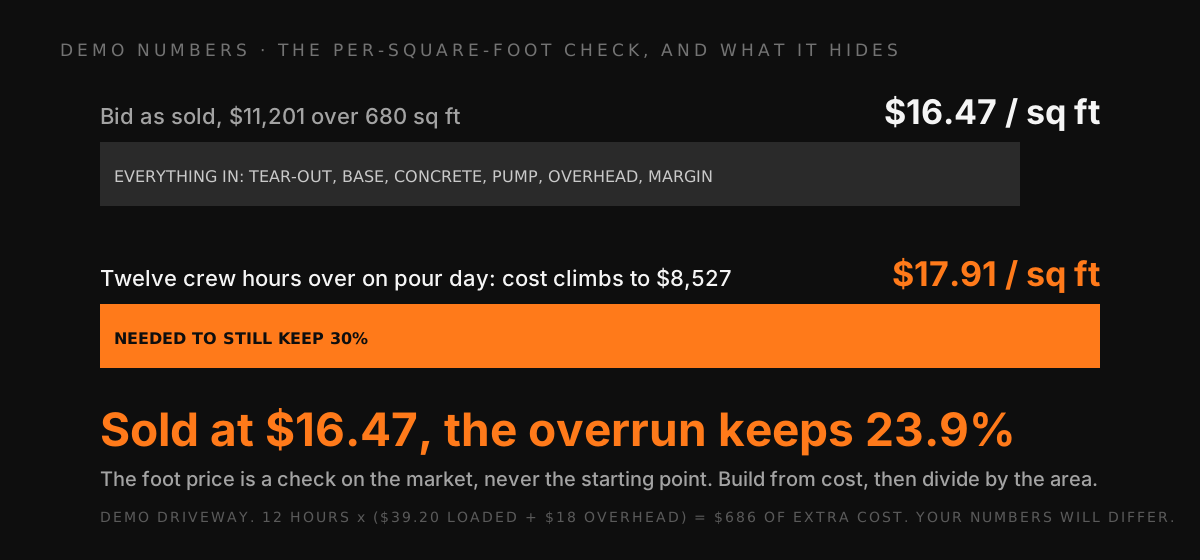
Divide the bid by the area. Demo: $11,201 over 680 square feet is $16.47 per square foot, everything in. Now look at it against your market, knowing what "your market" numbers usually leave out.
A Minnesota contractor seven years in posted his own foot prices in 2025: “I have been $6-6.50 a sqft for 4" broom finish concrete and hard trowel floors.” Those are his numbers in his market, and the thread title was “Losing Every Bid Damn Near.” He said himself he was bidding “incredibly low for my area” to get his name out. Even so, whether any $6.50 works depends on what it covers. Labor only with the builder buying the mud is one product. Turnkey with tear-out, base, a pump, and haul-off is another. Compare a turnkey foot only to a turnkey foot. Ask what a foot price includes before you let it move yours.
The per-foot check also shows what an overrun costs. Twelve crew hours over on pour day takes the demo cost to $8,527. The $11,201 bid as sold then keeps 23.9 percent, not 30. To still keep 30 percent, the bid would have needed to be about $12,182, or $17.91 a foot. That is the margin of safety a foot price never shows you.
The bid mistakes that keep showing up in the threads
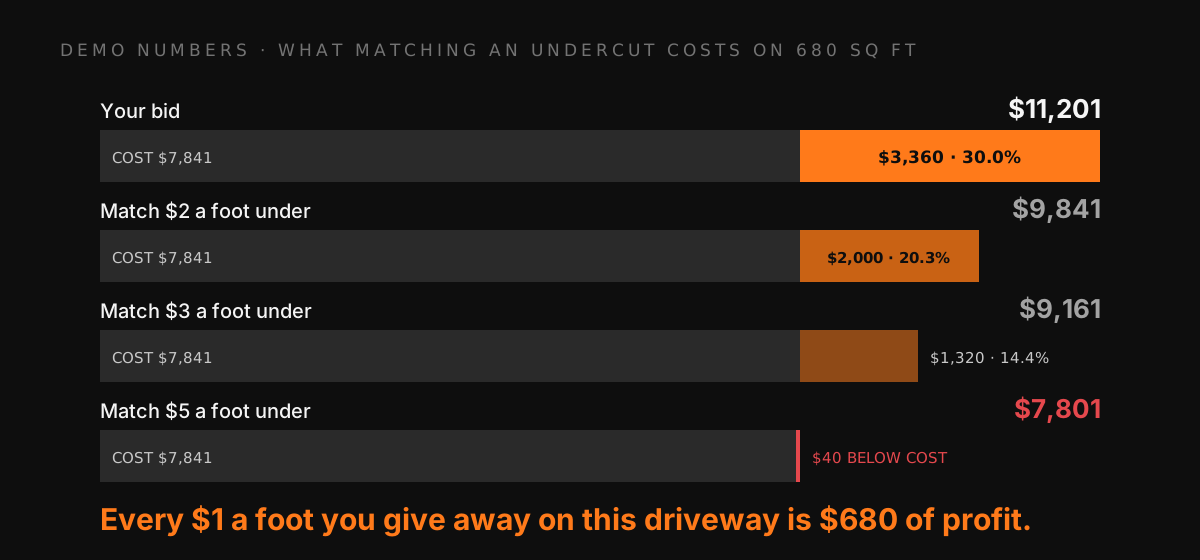
Letting the competitor set your price. A Maine contractor on Breaktime said it in 2003 and it has aged fine: "Guys who constantly bid at bottom doallart and are forced to do so by letting their competition set their prices end up losing moiney, going out of business" (typos his). The math on the demo is brutal. Match a rival who is $2 a foot under you on 680 square feet and you hand over $1,360. That is 40 percent of the $3,360 profit. Match $5 a foot and the job is below cost.
Reading the tip wrong. A renovation contractor who does small flatwork posted in 2022 about a driveway extension with a curb: "I billed 4200 and got a healthy tip." The thread title was his own verdict: "If you get tipped you didn't charge nearly enough." A tip is the customer telling you the price was low.
Skipping the two hidden lines. Wages instead of loaded labor, and no overhead share. On the demo those two lines are $717 and $1,152. Price the felt cost of $5,972 for a 30 percent margin ($5,972 ÷ 0.70) and you sell the job for $8,531. That leaves an 8.1 percent margin after the real cost. Nothing went wrong on that job. The bid was short two lines.
No weather line. A Georgia contractor prepping a footing in 2014 put it plainly: "Yes pretty much screwed! Hasn't rained in weeks and the second we start prepping for a Footing pour the rain comes!" His follow-up a month later counted almost ten days of rain delays. A standby day is a real cost. Decide in the bid who eats it.
Pouring before the deposit clears. A Florida contractor asked Levelset in 2022 what to do about a homeowner refusing to pay for "10 yards of concrete and rebar that have already been laid and poured." His question is public. You cannot un-pour. Get the material deposit before the truck is scheduled, and put the payment schedule in the same document as the scope.
After you win it, the bid is the plan
The number you just built is the plan on the day you send it. Then the pour happens. The subgrade fights back, the truck is late, the finish runs past dark, and the margin moves with every hour the crew is out there. Nobody sees that on pour day unless the hours land on the job the day they happen.
That is the gap SiteOps fills. Crews clock in with GPS at the slab, so the hours land on that job the same day. Receipts get a job name at the supply house. Every job shows a daily profit and loss, so the 30 percent you bid becomes a number you watch instead of a number you hope for. See how SiteOps tracks job costs while the job is running, starting with GPS-verified time tracking.
Bid it here, then watch it there. The Concrete Bid Calculator prices the job before the truck rolls. SiteOps shows what the pour is making the same day, while the job is still open. Start a 14-day free trial.
FAQ
How do I bid a concrete job? Write the scope and figure the yards. Price the concrete as delivered. Add base, rebar, forms, cure, subs, pump, and equipment. Add crew labor at the loaded rate and an overhead share. Divide the total by one minus your target margin. That number is the bid. Divide the bid by the slab area to check it per square foot.
How much should I charge per square foot for concrete? Build the bid from your costs first, then divide by the area. On our demo driveway that is $11,201 over 680 square feet, or $16.47 per square foot with tear-out, base, concrete, pump, overhead, and margin included. Compare that only to other turnkey prices, because many per-foot numbers you hear leave out lines.
How many yards of concrete do I need for a driveway? Square feet times thickness in feet, divided by 27. A 680 square foot driveway at 4 inches needs about 8.4 cubic yards before waste. Add waste for uneven subgrade and thickened edges, then round up to what your plant will batch. With 5 percent waste and quarter-yard batching, the order is 9 yards.
What profit margin should I put on a concrete bid? No single number fits every shop. Margin is the share of the price you keep, and if overhead is already in your cost, the margin is what you keep after overhead. Divide cost by one minus the margin. A 30 percent margin on $7,841 of cost gives a bid of $11,201, which is a 42.9 percent markup on cost.
Should I bid concrete by the square foot or by the job? By the job, from your costs, every time. Express the finished bid per square foot as a check against your market, but never start from a foot price. A foot price cannot see tear-out, a pump, thickened edges, or a winter finish that runs past dark.
What do I do when another contractor bids way under me? Recheck your seven cost lines, then hold your number. If the other bid is below your own materials and labor, it is not a market price. It is someone else's mistake, and matching it hands your profit to the customer. Walk, and keep your crew for jobs that pay.
This article is general information for contractors, not accounting, tax, or legal advice. Dollar figures in the worked example are demonstration numbers, and quoted forum prices are the posters' own from their stated years. Confirm your real burden, overhead, and supplier fees with your accountant and your suppliers before you price work.