What to Charge Per Hour (and Why the Wage Is Not It)
October 9, 2026
"You cannot bid based on what other people are pricing their jobs at or you will go bankrupt."
That line came from an electrical contractor on the Mike Holt forum, answering a man who had lost a bid by $1,500 and wanted to know if he had overbid. He had not. He had no idea what his own hour cost him, which is a different problem and a much more common one.
What to charge per hour is arithmetic, not opinion. This post runs the arithmetic end to end on one wage, with every figure shown so you can swap in your own. It pairs with what a job costs you, which covers the cost side of a whole job, and with how to bid a concrete job if you want the bid walked through instead.
Every dollar figure below is demo math on one wage, not a market rate for any trade.
The formula, in one line
Wage, times burden, times paid hours in a year, times overhead and profit, divided by the hours you can actually bill.
Written as one expression:
rate = wage × (1 + burden%) × paid hours × (1 + overhead% + profit%) ÷ billable hours
That is the whole thing. Everything else in this post is about getting honest numbers into those five slots, because the formula is easy and the inputs are where contractors go wrong.
The number nobody divides by
Start here, because this is the part that costs the most money and gets discussed the least.
A full year is 2,080 paid hours. That is 40 hours across 52 weeks, and it is what your payroll actually pays out for a man who works all year.
Nobody bills 2,080 hours.
He drives between jobs. He runs to the supply house. He loads the truck in the morning and cleans it out on Friday. He stands in the rain in February. He goes back to fix something small, and that trip does not go on an invoice. Every one of those hours is a paid hour that is not a billable hour, and the money still leaves your account.
So when the year's cost gets divided, it cannot be divided by 2,080. It has to be divided by the hours that reached an invoice. For most residential and light commercial crews that is somewhere between 1,600 and 1,900 hours, and the only honest number is the one in your own records.
Track paid hours against billed hours for three months. That ratio is worth more than any rate table on the internet, including the one below.
Burden is not a paperwork detail
Payroll taxes, workers comp, general liability, and any paid time off all sit on top of the wage. Together they are usually somewhere between 15 and 35 percent, and the number depends on your trade, your state, your claims history and your policy.
Workers comp is the one that moves the most. A roofer and an estimator in the same company do not carry the same rate, and a bad claims year moves the whole number. If you have never read the rate off your own policy, that is the single highest-value hour you can spend this month.
If you want the longer version of this step, what a job costs you breaks burden down line by line.
One worked example, all the way through
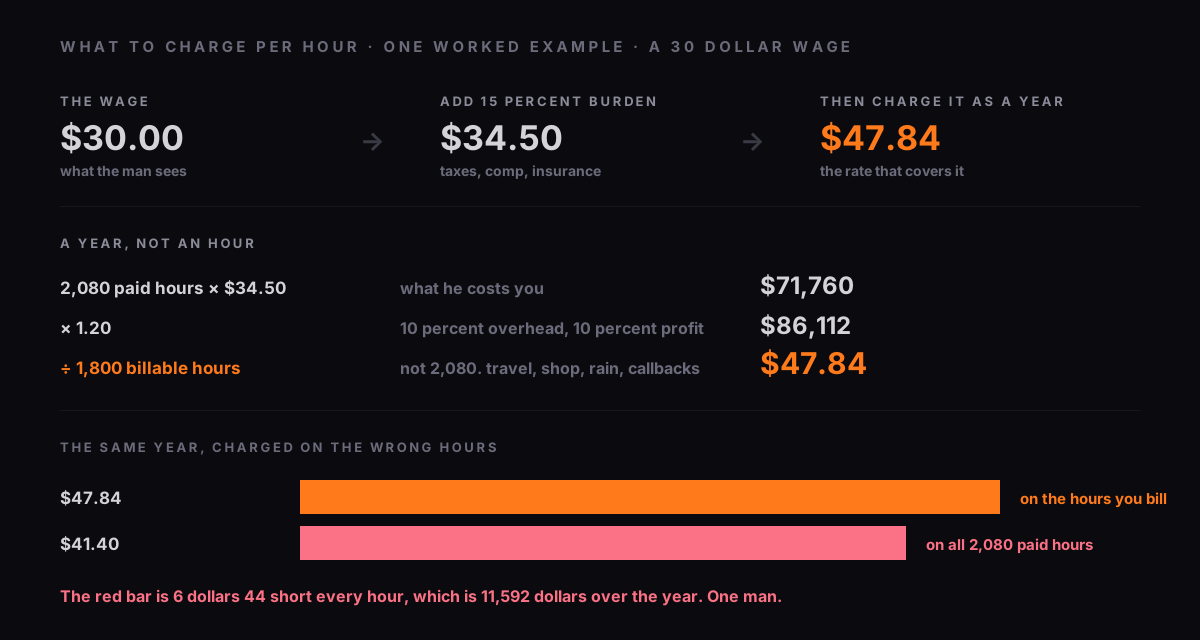
Take a $30 an hour wage. Not a rate, a wage, meaning it is what the man sees on his check.
| Step | Working | Result |
|---|---|---|
| The wage | what he sees | $30.00 |
| Add 15 percent burden | $30.00 × 1.15 | $34.50 |
| A year of paid hours | $34.50 × 2,080 | $71,760 |
| Add overhead and profit | $71,760 × 1.20 | $86,112 |
| Divide by billable hours | $86,112 ÷ 1,800 | $47.84 |
The rate is $47.84 an hour.
Read that against the wage one more time. The man earns $30. The hour sells for $47.84. That gap is not greed, it is the burden, the shop, the truck, the insurance, the unbillable hours, and the profit the company has to keep to still be there in March.
Now run the same year the wrong way, dividing by the 2,080 paid hours instead of the 1,800 billable ones: $86,112 ÷ 2,080 = $41.40.
That is $6.44 short on every single hour. Across the 1,800 hours, it is $11,592 a year, for one man. Charge that way for a five man crew and the number stops being a rounding error.
What the multiplier looks like
The multiplier is the rate divided by the wage. It is a fast sanity check, because you can work it out in your head on a job site.
Same assumptions throughout, which are 15 percent burden unless noted, 2,080 paid hours, 1,800 billable hours, 10 percent overhead and 10 percent profit.
| Wage | Burden | True cost an hour | Rate to charge | Multiplier |
|---|---|---|---|---|
| $22 | 15% | $25.30 | $35.08 | 1.59x |
| $25 | 15% | $28.75 | $39.87 | 1.59x |
| $30 | 15% | $34.50 | $47.84 | 1.59x |
| $35 | 20% | $42.00 | $58.24 | 1.66x |
| $45 | 25% | $56.25 | $78.00 | 1.73x |
| $60 | 25% | $75.00 | $104.00 | 1.73x |
| $85 | 30% | $110.50 | $153.23 | 1.80x |
Notice the multiplier climbing down the table. It is not a fixed 1.6x that you can apply forever. Higher wages carry higher workers comp classes, more burden, and often more unbillable time, so the multiplier that covers a $22 helper is not the one that covers an $85 foreman.
If you want the margin and markup half of this, markup vs margin runs that conversion, and the markup calculator does it in the browser.
The shortcuts that quietly lose money
Charging the wage plus a dollar. This is the most common one and the most expensive. It works right up until the truck needs brakes.
Using a rate you heard from another contractor. His overhead is not yours. His utilization is not yours. His workers comp rate is definitely not yours.
Adding overhead but forgetting profit. You have then built a rate that breaks even, which is a slower way to lose money than the first two.
Setting the rate once and never again. Wages move, insurance moves, and the billable ratio moves when the schedule gets tighter. A rate set two years ago is a rate for a business that no longer exists.
Quoting a day rate off the wrong hourly number. Same error, different unit. An eight hour day at $41.40 is $331.20. At $47.84 it is $382.72. That is $51.52 a day, and nobody notices because the day rate feels like a rounder number.
Turning the rate into a price
An hourly rate answers one question: what does an hour of this crew cost and what does it need to earn. It does not answer what a job costs, because a job is hours plus material plus everything else.
The order that works is rate first, then the job. Work out the real rate, then price the job from its cost with the rate already in the labor line. The last step is the margin, and if you have the cost right, that step is one division.
The thing that breaks all of it is the same thing every time: the rate is set from last year's numbers, the actual hours land somewhere else, and nobody finds out until the job closes. That is the part worth fixing with tracking rather than with a better spreadsheet.
Frequently asked questions
How do I calculate what to charge per hour? Multiply the wage by the burden percentage to get the true hourly cost. Multiply that by paid hours in a year, add your overhead and profit percentages, then divide by the hours you can actually bill. A $30 wage with 15 percent burden, 10 percent overhead and 10 percent profit lands at $47.84, not $30.
Why can't I just charge the wage plus a bit? Because the wage is what the man sees on his check, and it is the smallest number in the job. Payroll taxes, workers comp and insurance sit on top of it, then a share of the shop, trucks, fuel and office, and only then the profit the company keeps. Charging the wage plus a bit means the overhead comes out of your own pocket.
What is a billable hour? An hour you can put on an invoice. Travel between jobs, supply house runs, shop time, equipment maintenance, rain days and callbacks are paid hours that are not billable. If you pay 2,080 hours a year and bill 1,800 of them, those 280 hours still cost money and the rate has to carry them.
How many hours a year can a crew actually bill? Fewer than the 2,080 in a standard work year, and the only honest number is your own records. Track paid hours against hours that reached an invoice for three months and you will have your own utilization figure. Until then, run the arithmetic twice, once at 1,800 hours and once at 1,600, and see how much the rate moves.
Should the hourly rate include profit? It has to, or the profit never arrives. Overhead and profit are separate percentages added on top of the job cost, and both belong in the rate. Labor burden is a cost you pay whether the job makes money or not. Profit is what the company keeps, and a rate that leaves it out is a rate that keeps nothing.
Why is my hourly rate different from the one I see quoted online? Because a quoted rate is somebody else's business, not yours. It carries their wage scale, their burden, their overhead, their utilization and their market. The formula is the same everywhere and the inputs are yours alone. Work yours out from your own books and ignore the number in the forum.
General information for contractors, not accounting, tax, or legal advice. Every dollar figure in the worked example is demo math on one wage, not a market rate for any trade. Burden and workers comp percentages depend on your trade, your state, your policy and your claims history, so read yours off your own documents and run the numbers past your CPA.